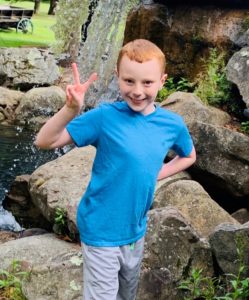














Amy from the USA is Griffin’s mother. Here she tells us their journey to diagnosis, encompassing multiple hospitals and treatments, and the impact living with r(20) syndrome is having on the whole family.
Thriving to surviving
Griffin was a very active, silly, and caring 5.5-year-old boy. He had just finished Pre-K and was hitting many milestones; he was thriving. Early in the summer of 2023, we noticed a short episode where Griffin didn’t respond to us and seemed a bit limp. When he came out of it laughing, we thought he was just playing. Two days later, Griffin had a noticeable absence seizure. He emerged from it crying and distraught, but then went off to play at the playground. As a nurse, I recognized what had happened, but I tried to remain calm, unaware of how much our lives were about to change.
Just two days later, Griffin had a tonic-clonic seizure. Thankfully, his sister was at summer camp and his little brother was sleeping.
It was one of the scariest moments of my life; he turned blue, and I felt completely helpless. As a nurse, I wanted to hit a code blue button, grab my oxygen and suction equipment, call my team for help, etc., but it was just us and our child, waiting for EMS.
Tests, re-tests, treatment after treatment…
The rest of the summer was filled with hospital visits. At the U of M Masonic Children’s Hospital, his MRIs, autoimmune tests and initial genetic testing was normal, but the EEGs were very abnormal. He was on three anti-seizure medications, and we added a fourth. They struggled to get Griffin’s seizures under control.
Then at Minnesota Epilepsy Group, right before Christmas, our sweet warrior underwent another MRI (normal), lumbar puncture (normal), autoimmune panel (normal), and EEG (abnormal). His epileptologist recommended a round of high-dose steroids and added a new medication. We experienced a stretch of 10 days with no clinical seizure activity, which felt like a significant win.
However, things slowly returned to being uncontrolled. Over the next 2-3 months, we made minor medication adjustments and tried IVIG twice due to his positive response to the high-dose steroids. By April, we were in a terrible spot: seizures were frequent, sometimes lasting over 20 minutes, and he wasn’t responding to rescue medications. The doctors considered transferring him to the PICU (pediatric ICU). Thankfully, we switched our epileptologist, who then helped stabilize his condition.
At the Mayo Clinic, Griffin underwent another MRI (normal), lumbar puncture (normal), specific lab work, GenDx testing (normal), autoimmune panel (normal), and another EEG (abnormal).
Finally, a diagnosis…
Almost a month later, we received a lab result via an online portal: Griffin has Mosaic Ring 20 Chromosome Syndrome.
I have a love-hate relationship with these portals; receiving such difficult news without anyone to discuss it with until Monday was challenging.
Notably, we were informed that few facilities conduct the type of karyotype testing that the Mayo Clinic performed, which involved examining his Chromosomes under a microscope to identify the ring.
Where are we now…
Griffin’s seizures have remained very uncontrolled. He does not have any obvious triggers; their frequency and nature seem to change depending on the medication combinations we try. At times, he experiences a lot of nocturnal seizures, while at other times, he clusters short daytime seizures. His seizures are typically focal but can also be absent or partially aware. As of fall 2024, he is on five anti-seizure medications and following the Modified Atkins diet, but I can’t remember the last time he had a seizure-free day. In January 2025 he had a VNS implant fitted.
Family impact
Everything in our life has had to change. His older sister has become a tremendous help and advocate for him, while his little brother constantly checks if he is “okay.” Coping with these changes and the uncertainty of our family’s future has been indescribably challenging. The weight of our decisions feels immense. However, we are incredibly fortunate to be surrounded by supportive family, friends, community, church, school, etc. Without these people, I can’t imagine where we would be.
We have learned to give ourselves grace and to take life one day—sometimes even one hour—at a time. We lean on our faith and accept help from those who offer it.


My hopes:
We have hope for our son’s future and will continue to advocate for him and explore new options.
Our hope is to provide additional support, hope, and encouragement to other families navigating unexpected and difficult journeys with their children.
Amy has setup a website to raise funds to help families similarly affected by rare and complex epilepsies. You can take a look and show your support here: StrongBraveHopeful